Agentic AI: A Practical Guide and Learning Roadmap for Software Developers in 2026
Artificial intelligence is moving beyond simply generating text, code, images, and answers. In 2026, one of the biggest changes in AI is the rise of Agentic AI systems that can understand a goal, plan the steps needed to achieve it, use tools, make decisions, and complete tasks with less human intervention.
For software developers, this change is creating a new set of opportunities. Instead of using AI only as a coding assistant or chatbot, developers can now build applications where AI can reason through problems, interact with APIs, retrieve information, execute actions, and coordinate multiple tasks.
But what exactly is Agentic AI? How is it different from Generative AI? And what should developers learn to start building AI powered applications?
This guide covers the fundamentals of Agentic AI for developers, explains the difference
between Agentic AI and Generative AI, and provides a practical roadmap for learning Agentic AI in 2026.
What Is Agentic AI?
Agentic AI refers to AI systems that can work toward a specific goal by planning, reasoning, using tools, taking actions, and adapting based on the results.
Traditional AI applications generally respond to a specific input. For example, you ask an AI model a question, and it generates an answer.
An Agentic AI system goes a step further.
You can give an agent a goal such as:
Research the latest information about a technology, compare the available options, and prepare a summary.
Instead of producing one response immediately, an AI agent can break the goal into smaller tasks, decide what information it needs, use tools to retrieve that information, evaluate the results, and produce an output.
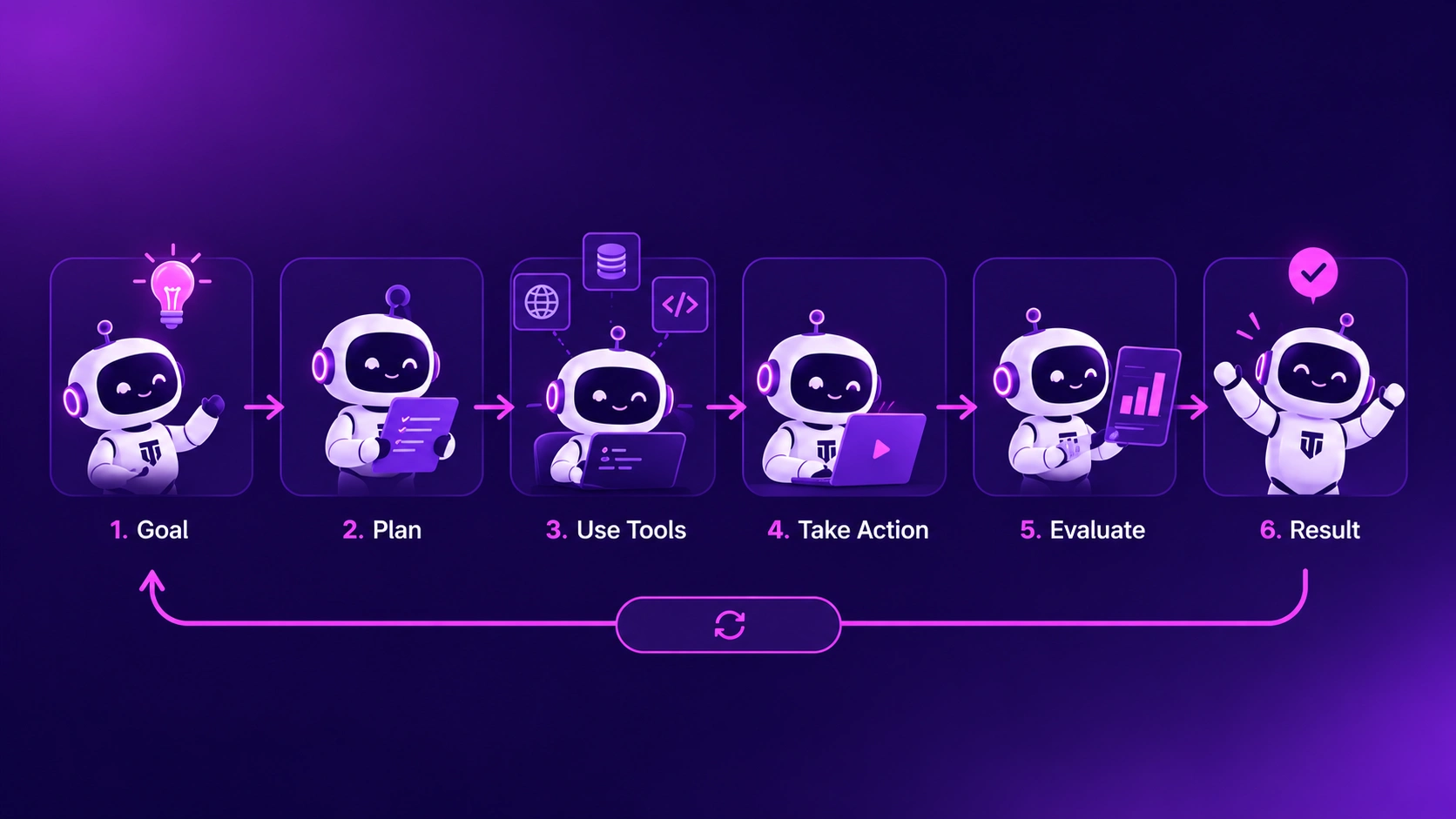
A simplified Agentic AI workflow can look like this:
Goal → Planning → Tool Use → Action → Evaluation → Next Action → Result
This ability to work through multiple steps is what makes Agentic AI particularly useful for software development and business applications.
How Does Agentic AI Work?
An AI agent typically combines several capabilities rather than relying only on a language model.
1. Reasoning
The system needs to understand the task and determine what needs to happen next.
For example, if an agent is asked to investigate a software issue, it may need to identify the problem, inspect relevant information, determine possible causes, and decide what action to take.
2. Planning
Complex tasks often require multiple steps. An agent can create a sequence of actions instead of trying to complete everything in a single response.
3. Tool Calling
Tools allow an AI agent to interact with external systems.
These could include:
● APIs
● Databases
● Search systems
● Code execution environments
● Business applications
● Internal company tools
● File systems
Tool calling is one of the most important concepts developers need to understand when building Agentic AI applications.
4. Memory and Context
Agents may need information from previous interactions or information retrieved from external sources to complete a task effectively.
This can involve conversation history, databases, vector stores, or other forms of persistent context.
5. Feedback and Evaluation
An agent may evaluate the result of an action and decide what to do next.
For example, if an API call fails, the agent could identify the error, adjust the request, and try again.
This creates a more dynamic workflow than a simple input-and-output AI application.
Agentic AI vs Generative AI: What Developers Need to Know
Generative AI and Agentic AI are closely related, but they are not the same thing.
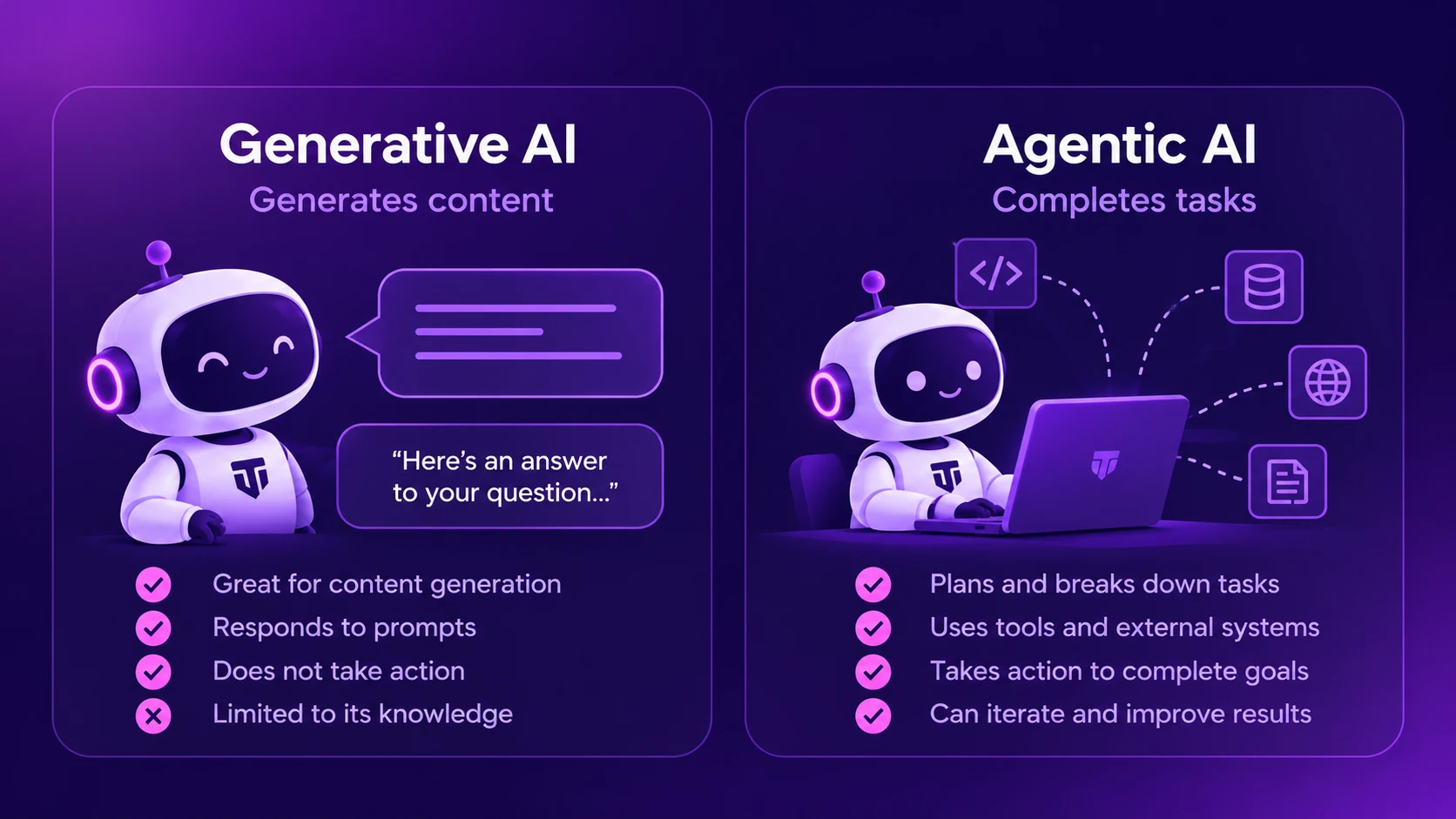
Generative AI primarily focuses on creating content. Agentic AI focuses on achieving goals through actions and decisions.
For example, a Generative AI model can generate:
- Text
- Code
- Images
- Summaries
- Ideas
- Documentation
An Agentic AI system can use generative AI as part of a larger workflow to:
- Understand a goal
- Break it into tasks
- Search for information
- Call APIs
- Retrieve data
- Execute actions
- Check results
- Continue working toward the goal
Think of it this way:
Generative AI – Create something.
Agentic AI – Figure out what needs to be done and take the necessary steps.
This does not mean Agentic AI replaces Generative AI. In many cases, generative models are the reasoning or language component inside an AI agent.
The important shift for developers is understanding how to build the system around the model.
Why Should Software Developers Learn Agentic AI in 2026?
AI is changing how software is developed and how software products are built.
Developers are increasingly expected to understand more than traditional application development. AI-powered features, intelligent automation, AI agents, retrieval systems, and tool integrations are becoming part of modern software applications.
For developers, learning Agentic AI can help bridge the gap between traditional software engineering and AI application development.
The advantage is that software developers already have many of the skills needed.
Programming, APIs, databases, backend architecture, authentication, debugging, testing, and system design are all highly relevant when building AI-powered applications.
The goal is not necessarily to become a machine learning researcher.
Instead, developers can learn how to engineer applications that use AI effectively.
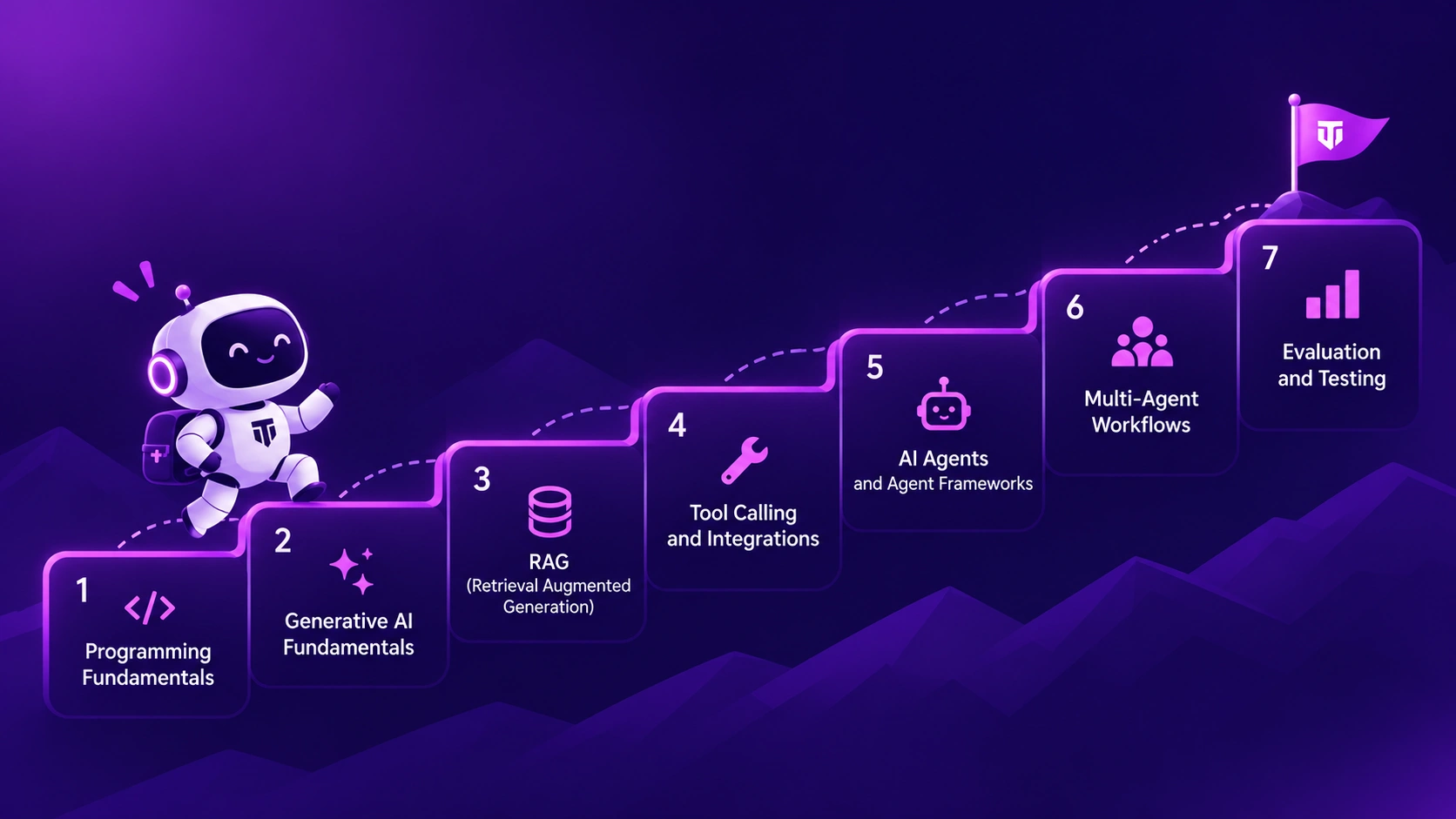
A Developer’s Roadmap to Learning Agentic AI
If you are a software developer wondering how to learn Agentic AI, you do not need to learn everything at once.
A structured roadmap can make the transition much easier.
Step 1: Strengthen Your Programming Fundamentals
Before building advanced AI agents, make sure your programming fundamentals are strong.
Focus on:
- A programming language such as Python, JavaScript, C#, or Java
- Object-oriented programming
- APIs
- HTTP and REST
- JSON
- Authentication
- Databases
- Git and version control
- Debugging and testing
These fundamentals become especially important when AI agents need to interact with real applications and external systems.
Step 2: Understand Generative AI Fundamentals
Next, learn how modern AI models work from an application-development perspective.
You should understand concepts such as:
- Large Language Models
- Prompt engineering
- Context windows
- Tokens
- Structured outputs
- Embeddings
- Model APIs
- AI application architecture
You do not need to start with advanced mathematical theory. Focus first on understanding how developers can integrate AI models into applications.
Step 3: Learn RAG
Retrieval-Augmented Generation (RAG) is an important concept for developers building AI applications.
Instead of relying only on the information contained in a model, RAG allows an application to retrieve relevant information from external sources and provide that information to the model.
This is useful for applications such as:
- Document assistants
- Internal knowledge systems
- Customer support applications
- Enterprise search
- Technical assistants
Understanding RAG gives developers a strong foundation for building more useful AI systems.
Step 4: Learn Tool Calling
Tool calling is a major step toward Agentic AI.
You need to understand how an AI model can decide to use a function or external tool.
For example, an AI agent might have access to tools for:
Search → Database → Calculator → API → Code Execution
The model determines which tool is required, provides the necessary inputs, receives the result, and continues the workflow.
This is where AI applications begin moving from simple chat interfaces toward action-oriented systems.
Step 5: Build AI Agents
Once you understand models, RAG, and tool calling, start building agents.
Begin with simple use cases.
For example:
A research agent
The agent receives a topic, searches for information, evaluates the results, and produces a structured report.
Then move toward more advanced workflows involving multiple tools and decision-making steps.
Step 6: Learn Multi-Agent Workflows
Some complex tasks can be divided between multiple specialized agents.
For example:
Research Agent → Analysis Agent → Writing Agent → Review Agent
Each agent can have a specific responsibility while working together toward a larger goal.
Understanding multi-agent workflows can help developers design systems for more complex automation and enterprise use cases.
Step 7: Learn Agent Evaluation and Testing
Building an AI agent is only part of the job.
Developers also need to understand how to test whether an agent is producing reliable results.
Important areas include:
- Accuracy
- Reliability
- Tool-use errors
- Hallucinations
- Latency
- Cost
- Security
- Observability
- Human-in-the-loop workflows
This is especially important when agents are given permission to interact with real systems.
What Can Developers Build with Agentic AI?
Agentic AI can be applied to many software development and business workflows.
Examples include:
AI Coding Agents
AI systems can help developers understand codebases, write code, debug issues, generate tests, and work through multi-step development tasks.
Customer Support Agents
Agents can understand customer requests, retrieve information, interact with internal systems, and provide responses or take approved actions.
Research Agents
Research agents can gather information from multiple sources, organize findings, compare results, and create structured reports.
Business Automation
Agents can connect different tools and automate workflows that previously required several manual steps.
Software Engineering Agents
Developers can build systems that assist with tasks such as code analysis, testing,
documentation, issue investigation, and development workflows.
The possibilities are expanding as AI models become more capable and developers build better tools around them.
What Skills Should an Agentic AI Developer Have?
An Agentic AI developer needs a combination of software engineering and AI application skills.
A strong skill set can include:
- Programming
- Backend development
- APIs and integrations
- Database systems
- Generative AI
- Prompt engineering
- RAG
- Tool calling
- AI agents
- MCP
- Multi-agent workflows
- AI application architecture
- Testing and evaluation
- AI coding tools
- Security and observability
The key is not simply knowing how to use an AI chatbot.
The valuable skill is knowing how to design, build, integrate, test, and deploy AI-powered systems.
The Future of Agentic AI for Software Developers
Agentic AI is changing the role of AI from something that simply responds to something that can participate in a workflow.
For developers, this creates an important opportunity.
The next generation of software applications may not be built around traditional interfaces alone. They may include AI agents that can understand goals, interact with tools, retrieve information, and complete multi-step tasks.
That means developers who understand both software engineering and AI systems can play an important role in building these applications.
You do not need to abandon your existing development experience to learn Agentic AI.
Instead, think of Agentic AI as an extension of what you already know.
Your programming experience gives you the foundation. AI concepts give you new capabilities. Agentic workflows connect the two.

Contact
- +91 8086 808 303
- sidillus.connect@gmail.com